You track registration numbers, retention rates, and participation trends. Here is a number that should reframe how you read those reports: 7 in 10 adolescent girls avoid physical activity during their period (Women in Sport, 2022). Many of them aren’t telling you why they’re leaving—they’re just quietly not coming back.
The reasons are structural, not personal. White uniform shorts. Open-plan changing areas with no privacy. A culture where no adult has ever said the word “period” out loud. These are organizational design choices, and they are within your power to change. When you do, you send an unmistakable message: this program was built with menstruating bodies in mind, not adapted for them as an afterthought.
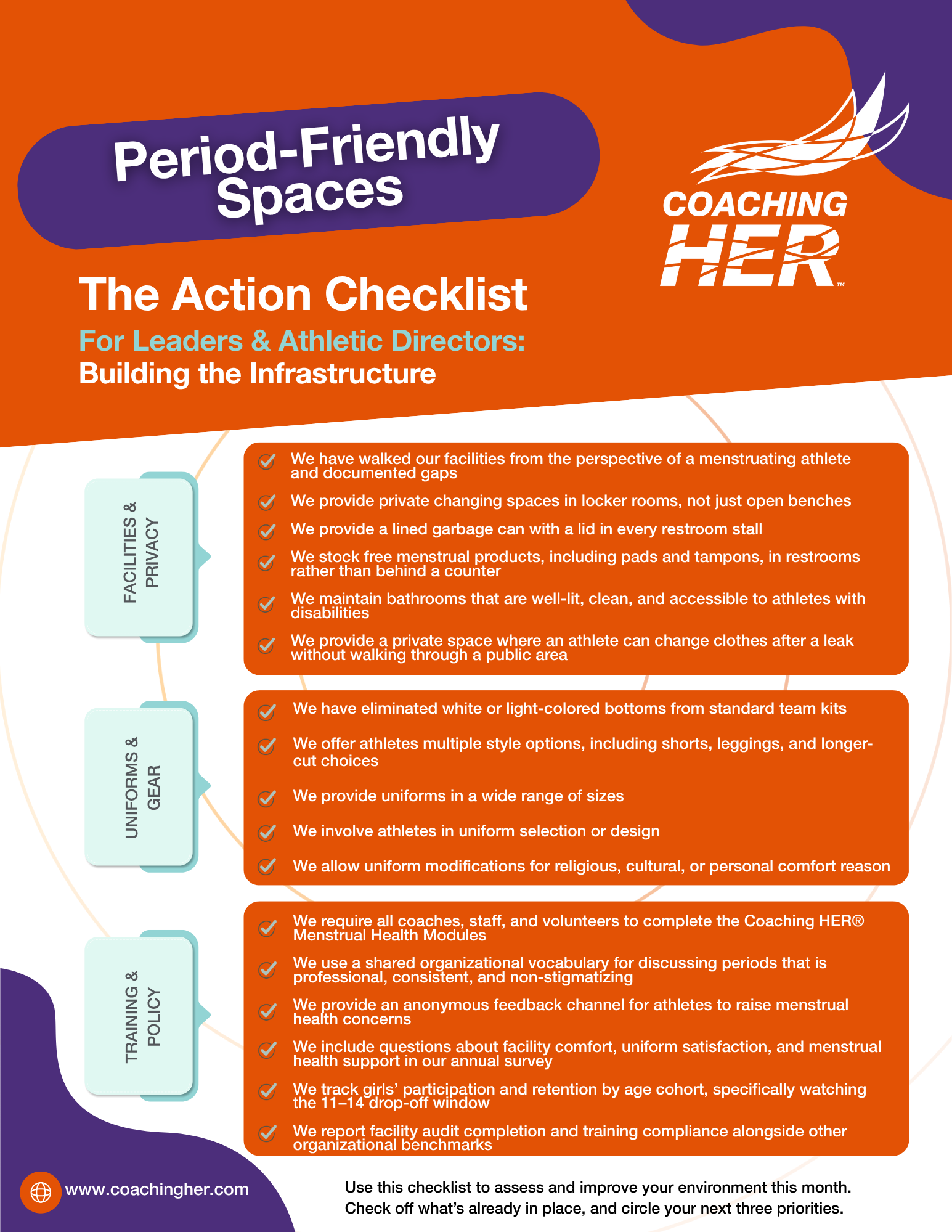
1. Run a Privacy and Hygiene Audit
Walk your facilities the way a 13-year-old experiencing her period for the first time would. That shift in perspective reveals gaps that spreadsheets miss.
Your Audit Checklist
- Do locker rooms and restrooms have private changing spaces—not just open benches?
- Is every stall equipped with a lined garbage can with a lid?
- Are free menstrual products (pads and tampons) available in restrooms—not just in the nurse’s office or behind a counter?
- Are bathrooms well-lit, clean, and accessible to athletes with disabilities?
- Is there a private space where an athlete could change clothes if she has a leak—without walking through a crowded hallway?
Document what you find, assign timelines, and budget for fixes. Even small changes—adding garbage cans, stocking a basket of products—signal that you’ve thought about the full athlete experience (UNESCO, 2024; Schneider et al., 2023).
BONUS Materials:
2. Redesign Uniform Policies for Confidence
Uniform anxiety is one of the top reported reasons adolescent girls disengage from sport (Canadian Women & Sport, 2024). White/light colored shorts, tight-fitting “male-style” kits, and limited size ranges create unnecessary stress for athletes managing their menstrual cycle.
Policy Changes That Matter
- Eliminate white or light-colored bottoms from standard team kits. Transition to dark colors across all programs.
- Offer multiple style options—shorts, leggings, longer-cut options—so athletes can choose what makes them feel most comfortable and confident.
- Stock a wide size range and involve athletes in the selection process. When girls help choose their uniforms, buy-in and comfort increase.
- Allow uniform modifications for religious, cultural, or personal comfort reasons.
3. Mandate Menstrual Health Training for All Staff
Research from the Coaching HER® program shows that while most coaches recognize menstrual symptoms impact training, only about 10% feel comfortable supporting adolescent girls with body-related challenges (Rally Report, 2024). That gap between awareness and confidence is exactly what organizational training closes.
Implementation Steps
- Require all coaches, staff, and volunteers to complete the Coaching HER® Menstrual Health Module as part of onboarding or annual professional development.
- Establish a shared vocabulary across your organization so that conversations about periods are professional, consistent, and non-stigmatizing.
- Create an anonymous feedback channel where athletes can share concerns about facilities, uniforms, or coach communication related to menstrual health without fear of judgment.
4. Measure What Matters
If you aren’t tracking it, you can’t improve it. Add period-friendliness to the metrics you already monitor.
- Include questions about facility comfort, uniform satisfaction, and menstrual health support in your annual athlete or parent survey.
- Track girls’ participation and retention rates by age cohort—watch specifically for the 11–14 drop-off window that coincides with puberty onset.
- Report on facility audit completion and training compliance alongside your other organizational benchmarks.
THE BOTTOM LINE
Period-friendly isn’t a nice-to-have—it is a retention strategy. Every facility upgrade, uniform policy change, and staff training session removes one more reason a girl might quietly walk away from your program. The organizations that get this right don’t just keep more girls—they build the kind of culture where every athlete knows she was expected, not accommodated.
References
Canadian Women & Sport. (2024). Rally Report 2024: A call to reimagine sport so all girls can play.
Goorevich, A., & Zipp, S. (2024). “They seem to only know about bleeding and cramps”: Menstruation, gendered experiences, and coach–athlete relationships.
PERIOD. (2025). 2025 State of the Period Report.
Schneider, J., et al. (2023). Body Confident Coaching: A pilot randomized controlled trial.
Tucker Center for Research on Girls & Women in Sport. (2024). Coaching HER: Menstrual health modules key takeaways.
UNESCO. (2024). Sport and Gender Equality Game Plan: Guidelines for gender-transformative sport policies and programme
.png?width=352&name=blog_header%20(3).png)
.png?width=352&name=blog_header%20(11).png)
.png?width=352&name=champions_guide_feb2026%20(1).png)
.png?width=352&name=blog_header%20(13).png)
.png?width=352&name=blog_header%20(19).png)
.png?width=352&name=blog_header%20(15).png)
.png?width=352&name=blog_header%20(5).png)