.png?width=1200&height=675&name=blog_header%20(21).png)
You remember the goals she scored. She remembers what you said after the game she lost.
That’s the truth about sport parenting, and it’s not a comfortable one. Research on girls in sport consistently shows that parents and guardians are among the most powerful influences on how a girl feels about her body, her abilities, and whether she wants to keep playing (Body Confident Sport, 2024; Canadian Women & Sport, 2022). And most of that influence doesn’t happen on the sideline. It happens on the car ride home.
As this season wraps up, or as you settle into its rhythm, this is an invitation to reflect. Not on her stats, but on her experience. And not on what you intended to communicate, but on what she actually heard.
Girls Are Listening Differently Than You Think
Girls’ communication styles tend to be more personal and relational than boys’--they prioritize connection and feeling heard (Women’s Sports Foundation, 2019). That means a casual comment about her performance, her body, or even another athlete’s body can carry more weight than you realize.
When you say “You looked great out there,” she might hear a compliment or she might hear that how she looked mattered more than how she played. When you say “Did you see how fast that other girl was?” she might hear motivation or she might hear that she doesn’t measure up. And when you say nothing at all after a hard game, she might interpret your silence as disappointment.
None of this means you’re doing it wrong. It means the car ride home is one of the highest-impact coaching environments in her life, and most of us have never thought about it that way.
Five Questions to Ask Yourself
Before the season ends, take ten minutes to reflect on your own. No one is grading you. This is for your growth—and hers.
- Did my support focus on her effort or her outcomes? Research on mastery-based environments shows that girls thrive when the adults around them praise effort, learning from mistakes, and bouncing back, not just winning (NIKE, 2020). Think honestly about what you celebrated most. Was it the goal, or the courage it took to try the new position?
- Did I comment on her body (or anyone else’s) this season? Body Confident Sport identifies parents as one of the strongest influences on a girl’s body image. Comments about weight, shape, food choices, or even “healthy eating” can land in ways you don’t expect. Comments about other athletes’ bodies (“She’s so tall, no wonder she’s good”) can trigger social comparison. The safest approach: talk about what bodies do, not how they look.
- Did the car ride home feel safe for her to be honest? If she’s quiet after games, it might not be because she’s tired. It might be because she’s learned that the post-game conversation is really about your feelings, not hers. A girl who feels safe to say “I didn’t have fun today” or “I don’t like my coach” is a girl who trusts you with the truth. A girl who has learned to manage your emotions on top of her own is carrying a weight she shouldn’t have to.
- Did I reinforce or undermine the coach’s message? When a coach builds a mastery-focused, effort-centered culture and then a parent asks “Did you win?” as the first question, the messages collide. You don’t have to agree with every coaching decision. But when the values you express at home contradict the values she hears at practice, she’s the one stuck in the middle.
- Did I model the body confidence I want her to have? Girls are watching. If you criticize your own body, avoid photos, or talk about diets at the dinner table, she is filing that information. Body Confident Sport research shows that parental body talk, even when it’s about your own body, shapes how she relates to hers.
Five Questions to Ask Her
If your daughter is open to it, these five questions can turn a ten-minute conversation into one of the most meaningful moments of her season. Ask them with curiosity, not an agenda. Listen without correcting. And don’t be surprised if the answers are different from what you expected.
- “What was the most fun part of this season?” Not the best, the most fun. Her answer tells you what she’s actually playing for.
- “Was there a time you felt really uncomfortable?” This opens the door to conversations about uniforms, body image, facilities, peer pressure, or coaching dynamics she may not have known how to bring up.
- “Did you feel like your coach knew you—not just as a player?” Girls’ sense of belonging is tied to whether they feel seen as whole people, not just athletes. Her answer reveals whether the 3Cs- Care, Competence, and Choice, were present in her experience.
- “Is there anything I said or did that made things harder?” This is the brave question. It might be hard to hear the answer. But asking it and genuinely listening models exactly the kind of vulnerability and growth you want her to develop through sport.
- “Do you want to play again next season?” If the answer is yes, celebrate it. If the answer is no or maybe, don’t panic. Ask why. The reasons girls leave sport are rarely about the sport itself, they’re about the environment around it. And those are things you can help change.
|
THE BOTTOM LINE You can’t control what happens during the game. But you can control what happens after it. The car ride home is the most underestimated coaching environment in youth sport and for girls, it’s often where the season is won or lost. Not on the scoreboard, but in her head. The question isn’t whether you had an impact this season. It’s whether the impact you had is the one you intended. |
|
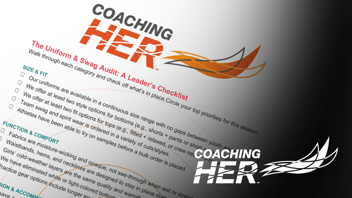
TAKE ACTION Download the Coaching HER® Coach’s Season Debrief Checklist. Even though it’s designed for coaches, the Social Environment section maps directly to the parent-athlete relationship. Walk through it alongside your own reflection—and use it as a conversation starter with your daughter’s coach. |
References
Body Confident Sport. (2024). Body Confident Coaching Key Takeaways. Nike, Dove, Tucker Center, Centre for Appearance Research.
Canadian Women & Sport. (2022). The Rally Report: A Call for Better, Safer Sport for Girls.
NIKE. (2020). Coaching Girls Guide: How to Get (and Keep) Girls Playing.
Women’s Sports Foundation. (2019). Coaching Through a Gender Lens: Maximizing Girls’ Play and Potential.


.png?width=352&name=blog_header%20(14).png)

.png?width=352&name=blog_header%20(6).png)