Sport can be a powerful place for girls and women to appreciate and trust their bodies, build confidence, and develop lifelong leadership skills. Yet for too many, sport can also become a source of pressure around body image, weight, fueling, and appearance—factors that can increase risk for disordered eating and eating disorders.
The Prevalence of Eating Disorders in Sport
Research shows that between 6% and 45% of female athletes experience disordered, higher rates than the general population (Ghazzawi, 2024). Additionally, clinical eating disorders are estimated to affect about 20% of female elite athletes (Fatt, et al., 2024). For coaches, that means these concerns are not rare side issues; they are athlete well-being issues that deserve the same attention as physical injury prevention. Even apart from the serious short- and long-term health risks, eating and body image issues can, and often do (though often in secret), significantly disrupt an athlete’s life, distract from performance, and undermine it.
The Coach's Enormous Influence on Team Culture
Coaches have enormous influence over team culture, establishing what is valued, prioritized, and expected. The language coaches use and allow, along with the behaviors they tolerate in practices, locker rooms, during team travel, and in competition, can either (almost always unintentionally) reinforce harmful appearance-based expectations or help athletes value and care for their bodies. In doing so, coaches help position athletes both for short- and long-term health, and a focus on performance, avoiding the “distraction” of body and food issues.
Defining a "Body Talk Free" Environment
Creating a “body talk free” environment may sound, at first, unnecessary or even silly. But when coaches eliminate appearance-based commentary and address it when it arises, athletes receive a powerful message: their bodies matter not because of how they look, but because of what those bodies make possible, which is just about everything, including participation, performance, and winning. A “body talk free” environment means appearance and weight comments and conversations have no place. The focus, instead, is on health and wellbeing, skill development, effort, learning, belonging, and performance. And aren’t these the very things that are essential to winning, rather than on body weight or appearance?
Performance, Vulnerability, and the Power of Prevention
This matters, not the least of which, because when an athlete feels self-conscious or dissatisfied with her body, her attention is pulled away from the game or competition. A volleyball player thinking about how her body looks in front of a crowd is not fully focused on the serve coming toward her. And if that same athlete is also trying to change her body through reduced energy intake, she is even less able to perform at her best because her brain and body are under-fueled.
Body dissatisfaction interferes with presence, confidence, and performance. It is also one of the strongest precursors to disordered eating: harmful thoughts and behaviors around food, exercise, and body size aimed at changing weight or appearance. Left unaddressed, disordered eating can escalate into a clinical eating disorder with serious short- and long-term health consequences.
That is why prevention through coaching education matters. Sport participation itself does not make someone inherently more vulnerable. But some of the traits that can help make a great athlete—drive, high pain tolerance, achievement orientation, discipline, high standards, determination, and more—can also make athletes especially vulnerable to harmful and pervasive cultural messages about how athletes’ bodies “should” look, alongside pressure to perform and excel. Coaches are uniquely positioned to interrupt those messages early, helping set athletes on a healthier and more sustainable path in sport.
Supporting Coaches: Resources from WithAll and the Tucker Center
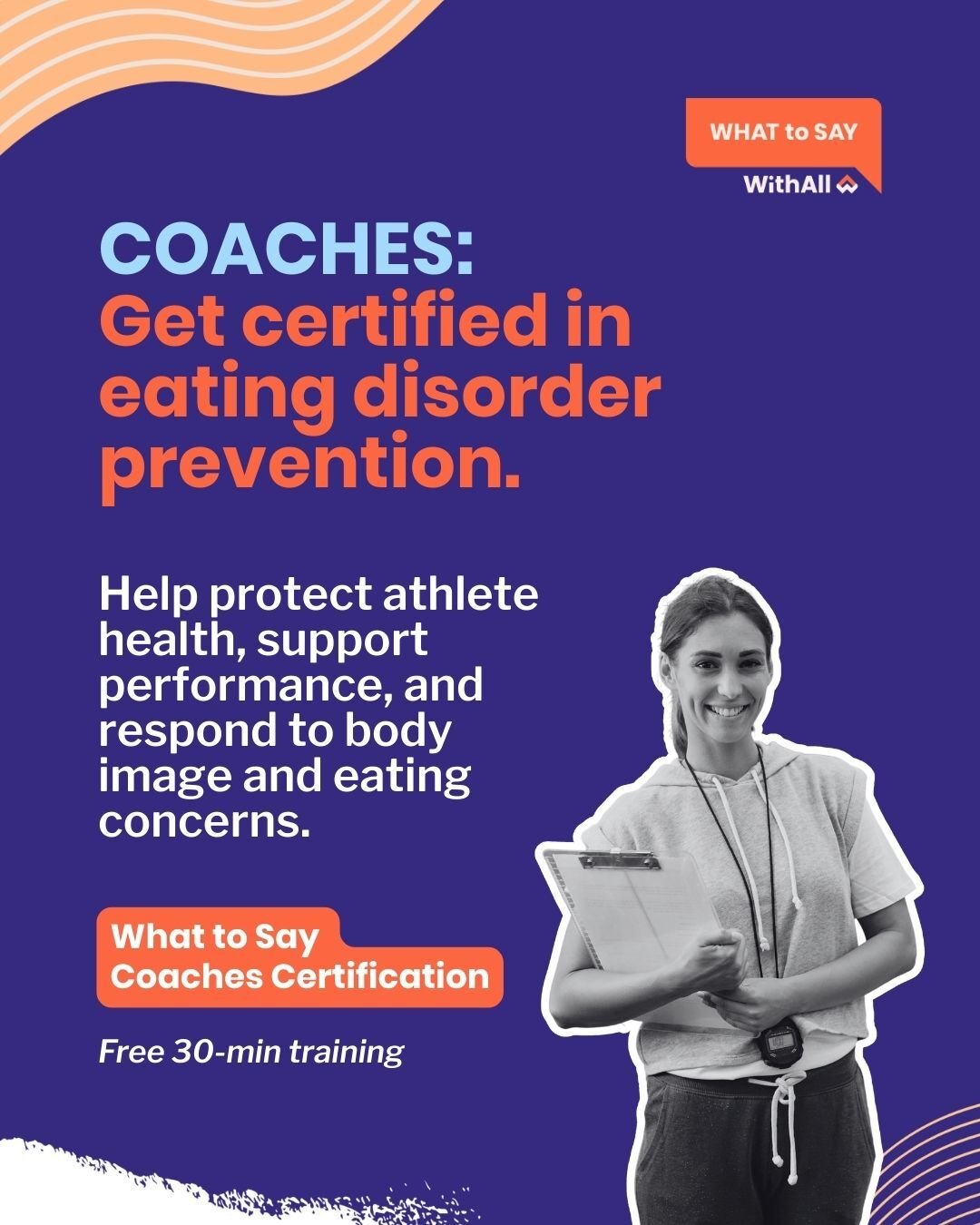
At WithAll, we help coaches build healthier sport environments through our What to Say Coaches Certification and free coach well-being resources. These tools help coaches recognize warning signs, use body-confident language, create team cultures centered on health and belonging, and support athletes in developing healthier relationships with food and their bodies.
This work aligns closely with the Tucker Center’s Coaching HER® efforts to improve the sport experience for girls and women. When coaches lead with body-confident language and athlete-centered values, they help create a culture where girls stay in sport longer, perform better, and build confidence that lasts far beyond the field.
References
Fatt, S. J., George, E., Hay, P., Jeacocke, N., Gotkiewicz, E., & Mitchison, D. (2024). Comparing population-general and sport-specific correlates of disordered eating amongst elite athletes: A cross-sectional study. Sports Medicine - Open, 10(1), 123. https://doi.org/10.1186/s40798-024-00791-9
Ghazzawi, H. A., Nimer, L. S., Haddad, A. J., Alhaj, O. A., Amawi, A. T., Pandi-Perumal, S. R., ... & Jahrami, H. (2024). A systematic review, meta-analysis, and meta-regression of the prevalence of self-reported disordered eating and associated factors among athletes worldwide. Journal of Eating Disorders, 12(1), 24. https://doi.org/10.1186/s40359-024-01521-1
.png?width=352&name=blog_header%20(14).png)

.png?width=352&name=blog_header%20(6).png)
.png?width=352&name=blog_header%20(21).png)